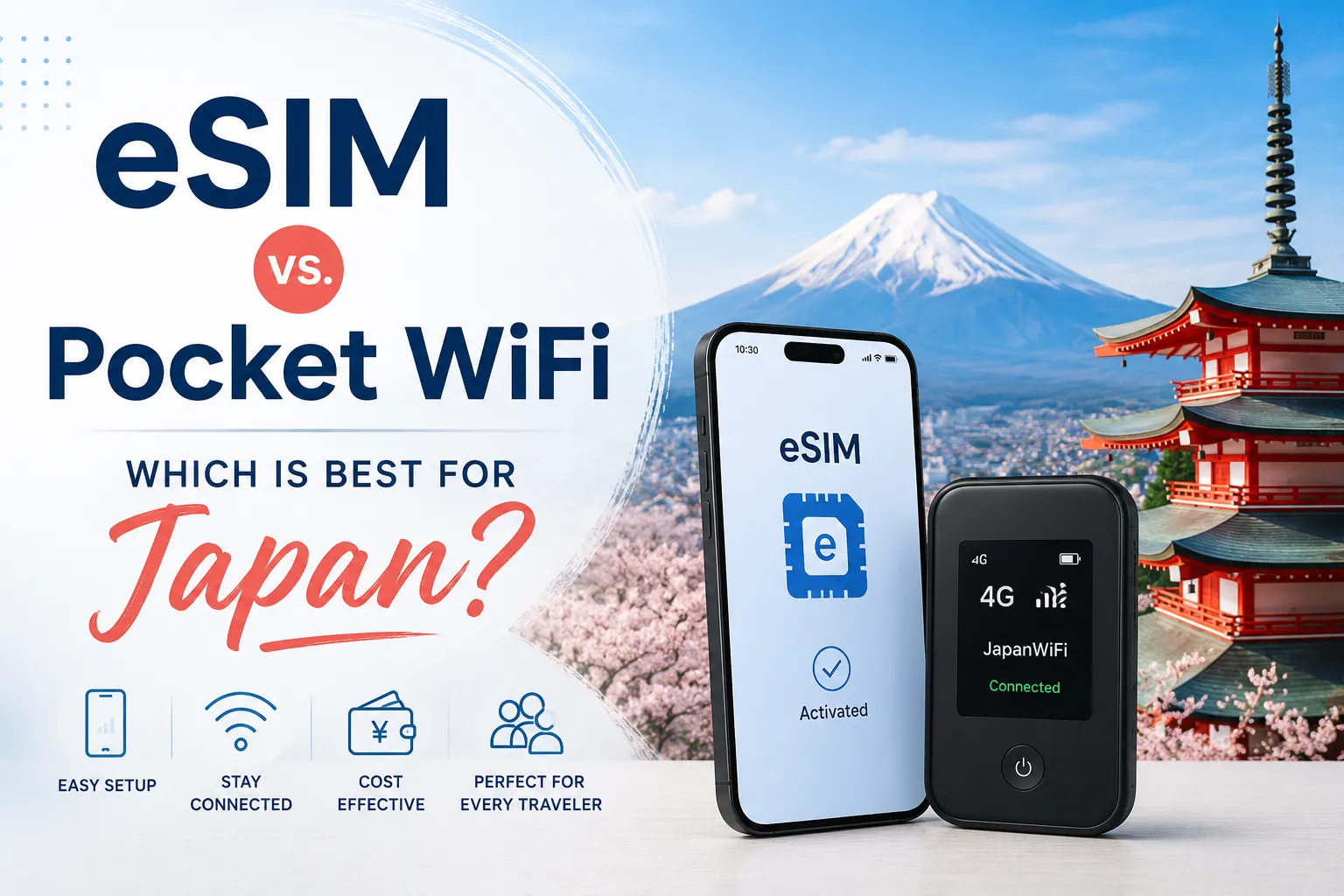
Should you get an eSIM or rent a pocket WiFi for your trip to Japan? We compare speed, cost, battery life, and convenience to help you choose the best option.

JPN Path
Editorial TeamStaying Connected in Japan: The Digital Travel Essential
High-speed internet access is not a luxury when traveling in Japan — it is an absolute necessity. From navigating complex multi-level train stations using Google Maps, translating menus and signs using Google Lens, to booking bullet train tickets on the fly, having reliable data is key to a smooth trip.
When planning your connectivity, you have two primary options: buying a digital travel eSIM or renting a physical pocket WiFi device. Historically, pocket WiFi was the default choice for tourists. However, with the rapid rise of eSIM technology, the decision has become more nuanced.
eSIM: $15 - $30 vs. Pocket WiFi: $4 - $8/day
Travel eSIMs offer a cheap, prepaid flat rate (e.g. 10GB for $18), whereas pocket WiFi is rented per day, making eSIMs highly cost-effective for solo travelers and couples.
eSIM vs. Pocket WiFi: Side-by-Side Comparison
Here is a complete comparison breakdown of how these two options stack up across crucial categories:
| Category | Travel eSIM | Pocket WiFi Rental | Winner |
|---|---|---|---|
| Setup | Digital download via QR code | Airport pick-up & drop-off | eSIM (Instant) |
| Physical Weight | None (100% digital) | Requires carrying a device & charger | eSIM |
| Battery Life | Uses phone battery | Lasts 6-9 hours (needs power bank) | eSIM |
| Multi-Device Support | Usually restricted to one device | Connects up to 5-10 devices | Pocket WiFi |
| Group Travel | Each traveler needs their own plan | Entire group shares one device | Pocket WiFi (For close groups) |
| Coverage & Speed | High-speed local networks (SoftBank/Docomo) | Premium unlimited speeds | Tie |
The Travel eSIM: The Modern, Lightweight Choice
An eSIM (embedded SIM) is a digital SIM card that allows you to activate a cellular data plan without using a physical nano-SIM. You simply purchase a plan online before your flight, scan a QR code to download the profile, and turn the line on the moment you touch down in Tokyo.
Pros of using a Japan eSIM
Instant Activation: Skip the long airport queues at rental counters. You activate it in your phone settings the second you land.
No Extra Devices: You do not have to carry around a separate battery-powered router, worry about charging it every night, or panic about losing it.
Keep Your Home Number: Since your physical SIM tray remains empty, you can keep your home SIM active in your phone to receive important security 2FA text messages from your bank.
Cons of using a Japan eSIM
Device Compatibility: eSIMs only work on carrier-unlocked smartphones that support eSIM technology (typically iPhone XR or newer, Google Pixel 3 or newer, and Samsung Galaxy S20 or newer).
Single Device: You cannot easily share your data connection with laptops or tablets, as hot-spot tethering on travel eSIMs is often limited or drains your phone battery rapidly.
Top Recommended eSIM (Airalo): Airalo is the global leader in travel eSIMs, offering highly stable coverage on SoftBank and Docomo networks. Buy Airalo eSIM
Alternative eSIM (Ubigi): Famous for premium speeds and seamless installation. Buy Ubigi eSIM
Pro-Tip: Check Lock Status
Before buying an eSIM, verify that your smartphone is completely carrier-unlocked. If your phone is locked to a specific carrier network, the travel eSIM profile will fail to download and activate.
A pocket WiFi (or pocket router) is a small, battery-powered wireless router that connects to local high-speed cellular networks and broadcasts a private WiFi signal. You rent the device at your arrival airport and return it at a postbox or airport counter before your departure.
Pros of using a Pocket WiFi
Unlimited Data: Most pocket WiFi rentals offer true unlimited high-speed data without daily throttling, making it ideal for streaming video or uploading high-resolution travel photos.
Multi-Device Connection: You can connect multiple smartphones, laptops, and tablets to the same hotspot.
Cost-Efficient for Groups: If you are traveling as a family or a close group of friends, sharing the daily cost of one pocket WiFi router is cheaper than buying individual eSIMs.
Cons of using a Pocket WiFi
Charging Dependency: The device runs on a battery that typically lasts 6 to 9 hours of active use. You must carry a portable power bank to keep it charged during long days of sightseeing.
Pickup & Return Logistics: You must queue up at Narita, Haneda, or Kansai Airport counters to collect the device, and remember to drop it off in a prepaid return envelope before leaving Japan. If you lose or damage the device, you face high replacement fees.
Top Pocket WiFi Rental: Rent a highly reliable pocket WiFi router through Klook for convenient airport pickup. Book Pocket WiFi
✓Choose an eSIM if...
- You are traveling solo or as a couple
- You hate carrying extra electronic devices and chargers
- Your phone is unlocked and supports eSIM technology
- You want to keep your home number active for 2FA bank texts
✕Choose a Pocket WiFi if...
- You are traveling as a family or group that stays together
- You need to connect multiple laptops or work devices
- Your phone is locked to a carrier or does not support eSIM
- You plan to stream massive amounts of video content
No matter which internet option you choose, we highly recommend setting up your transit card before you fly. You can load a digital transit card (Suica/Pasmo) directly into your smartphone wallet to tap through train gates instantly:
Digital Transit Card (Suica): Get Suica Details
Regional Trains (Shinkansen): Book your bullet train tickets online in advance to secure seat reservations. Book Shinkansen Tickets
Frequently Asked Questions
❓Can I use both an eSIM and my home SIM at the same time?
❓Where do I pick up my pocket WiFi rental?
❓What happens if I go over the data limit on my eSIM?
Create Your Perfect Japan Itinerary
Customized daily plans, optimized routes, and curated local food recommendations tailored to your travel style.
Start Planning Now ➔About JPN Path
Editorial TeamThe JPN Path Editorial Team consists of local travel curators, cultural historians, and writers dedicated to sharing authentic, practical, and highly detailed guides for exploring Japan.
Continue Reading
Ubigi eSIM Japan Review 2026: Is It Worth It for Travelers?
Looking for the best travel data in Japan? Read our in-depth Ubigi eSIM Japan review, covering speeds, pricing, network coverage, and how it compares to Airalo.

12 Best Hotels With Mount Fuji Views: Luxury Ryokans, Onsens & Budget Stays (2026 Guide)
Planning a trip to Japan? Discover the 12 best hotels with Mount Fuji views, from luxury ryokans with private onsens to budget-friendly stays. Learn the best time to visit and how to book the perfect room.